Multimodal ML research · Ongoing research
ADNI Multimodal NCDE
Built a Neural CDE pipeline for next-visit ADAS-13 forecasting on irregular ADNI longitudinal data.
Overview
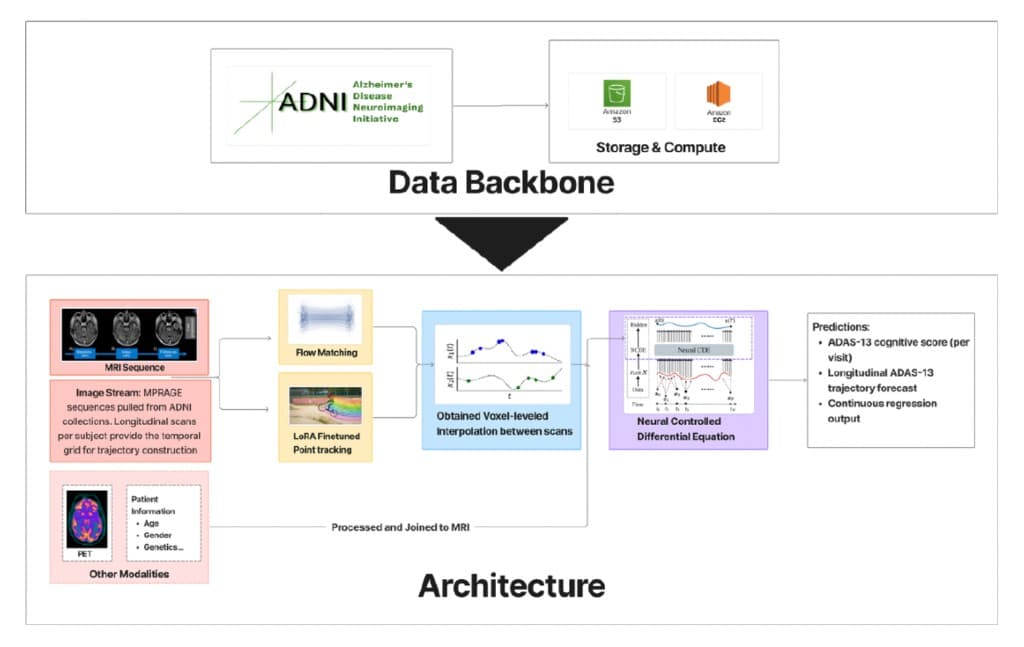
This project models Alzheimer’s progression as a multimodal longitudinal prediction problem, combining clinical history with MRI-derived trajectory features on AWS-backed ADNI data.
My contribution
AWS data backbone, MRI trajectory feature pipeline, Neural CDE benchmarking, and ADNIMERGE MMSE ablation experiments.
Problem
ADNI data is irregular across visits and spread across modalities, which makes it difficult to model next-visit outcomes faithfully with simple fixed-step sequence assumptions.
Approach
- Built an AWS S3/EC2 data backbone for ADNI MPRAGE sequences, PET scans, and clinical features (age, gender, genetics).
- Extracted voxel-level MRI trajectories via flow matching and LoRA-finetuned point tracking before feeding irregular visit histories into a Neural CDE.
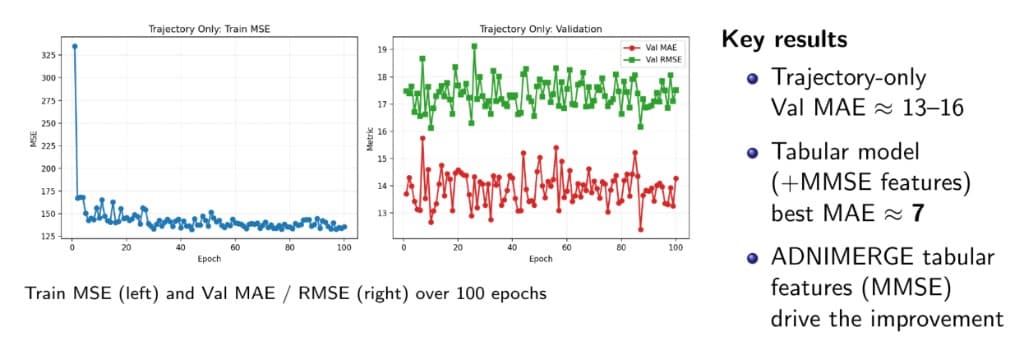
- Benchmarked trajectory-only models against tabular baselines with ADNIMERGE MMSE features to isolate what drives forecasting gains.
Result
Trajectory-only Neural CDE models reached validation MAE of ~13–16 on next-visit ADAS-13 over 100 epochs. Adding ADNIMERGE tabular features (MMSE) cut error to ~7 MAE — the best-performing configuration in current benchmarking.